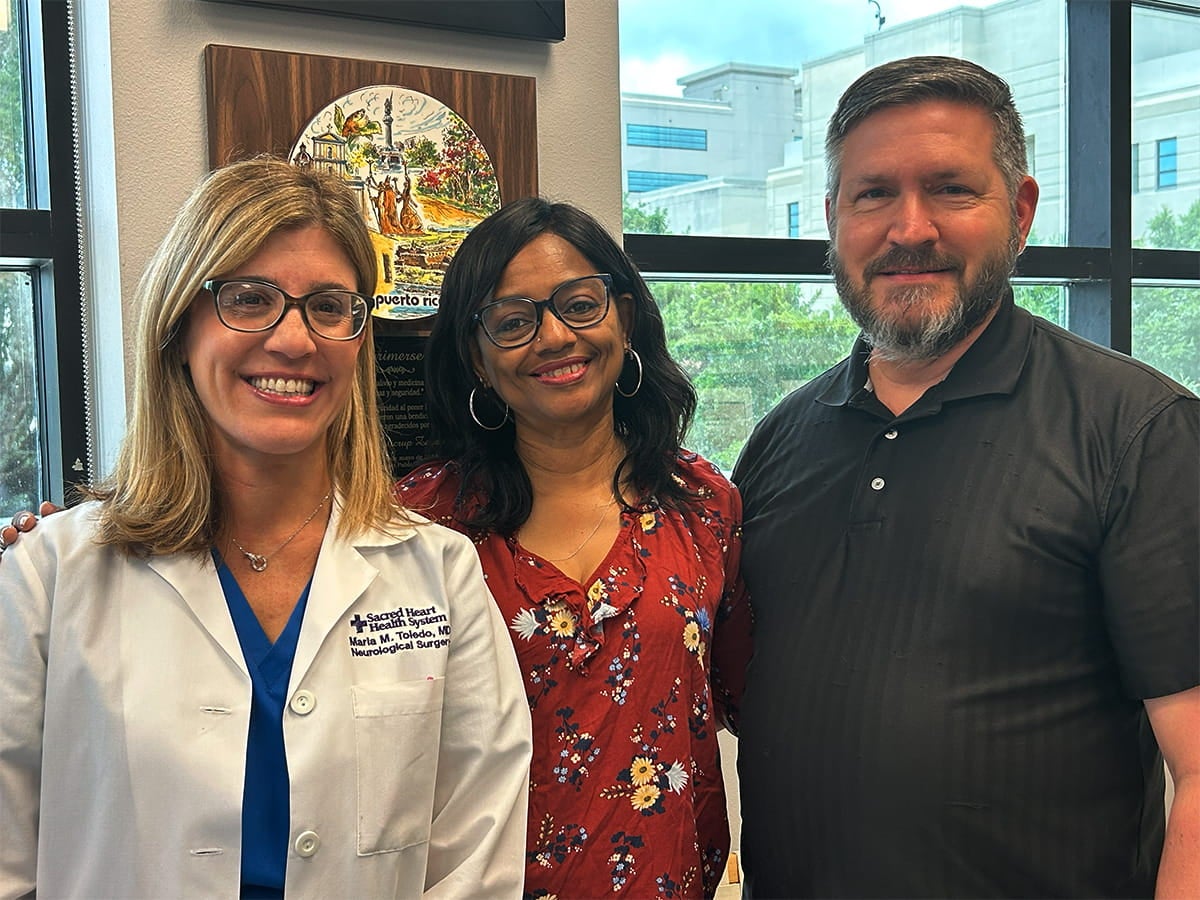
Scott Holland, a 52-year-old Pensacola resident, feels his life was saved twice on March 6. First when he survived a serious car crash, and again when the nationally recognized Comprehensive Stroke Team at Ascension Sacred Heart Pensacola quickly identified and treated the massive stroke that caused the accident.
Holland was driving on W Street in Pensacola when he suffered a stroke, causing him to crash into a pole and flip his car. He was transported to Ascension Sacred Heart Pensacola, the region’s only Level I Trauma Center, where emergency department staff initially treated him as a crash victim. But emergency physician Dr. Chelsea Grant quickly recognized signs of a stroke and activated a Stroke Alert, mobilizing the hospital’s specialized stroke team within minutes. Ascension Sacred Heart is home to the region’s only Comprehensive Stroke Center with a dedicated neuro ICU.
Tamara Holland described learning her husband had been in a car accident as “one of the worst nights of my life.”
“We didn’t know exactly what was happening until after his parents and I got to the hospital,” she said. “Then they told us about the stroke. Then they told us what they were going to do. Then they did it. And all of this happened within 45 minutes. I’m thankful for everybody who helped.”
The Stroke Center team confirmed a severe large vessel occlusion — a dangerous blockage in one of the brain’s major arteries. Dr. Maria Toledo, who led the procedure, said every second mattered.
“Because every second that passes, neurons are dying,” Dr. Toledo said. “We have to move very quickly because time is brain.”
The Comprehensive Stroke Center’s streamlined protocols ensured Holland was rapidly taken for advanced imaging, where AI-assisted software showed that much of the left side of his brain was at risk but still salvageable. Dr. Toledo then performed a thrombectomy, a minimally invasive procedure that uses a catheter to remove the clot and restore blood flow to the brain.
The thrombectomy took approximately six minutes, an exceptionally fast intervention that helped minimize permanent brain damage. To save additional time, Holland remained mostly awake during the procedure.
“Putting someone fully to sleep can take several minutes, and we want every minute we can get,” Dr. Toledo explained.
The fast action led to a remarkable recovery. Just four days later, on March 10, Holland was discharged from the hospital.
“I’ve had grandparents who suffered strokes and never fully recovered,” Tamara said. “Then four days later, he’s walking out of the hospital talking and laughing.”
Scott continues to recover well and has returned to many normal activities, with only minor lingering effects from the stroke.
“I’m very pleased and happy that Dr. Toledo was able to take care of my issues and get me set on the right path to recovery,” he said.
For Dr. Toledo, working in a demanding specialty where every second matters, seeing patients recover is what keeps her motivated.
“This makes it all worth it,” Dr. Toledo said. “It’s the fuel we need to keep doing this work.”
Holland’s story is also an important reminder to seek immediate emergency care for stroke symptoms, including sudden weakness, facial drooping, speech difficulty, confusion, or loss of balance. Rapid treatment can dramatically improve recovery outcomes and reduce long-term disability.
Toledo said Holland’s case also highlights the importance of having advanced trauma and stroke care available in one location.
“Sometimes, when a patient arrives after a major crash, the signs of stroke can be overlooked because the focus is understandably on the trauma,” Dr. Toledo said. “Scott was fortunate to be brought to a hospital equipped to handle both trauma and advanced stroke care at the same time. Having all those specialists working together can make the difference between lifelong disability and recovery.”