For many patients, an ultrasound provides answers that can shape some of life’s most important moments, from monitoring a healthy pregnancy to diagnosing a serious medical condition.
As one of the first steps in a patient's care journey, the speed, accuracy, and quality of the imaging experience can help build trust and confidence from the start. Faster, more precise imaging helps clinicians make informed decisions sooner, giving patients greater confidence in the care ahead.
As part of a three-year imaging innovation and investment strategy, Ascension is already seeing the impact of its first wave of investments: next-generation ultrasound systems that are strengthening clinical capabilities, improving efficiency, and expanding access across key service lines.
Improving care through next-generation ultrasound
By delivering higher-quality images in less time, new ultrasound technology is enhancing care across women’s health, maternal-fetal medicine, and other specialty areas. Enhanced capabilities allow clinicians to perform complex fetal heart assessments as early as 14 weeks, helping identify potential concerns earlier in pregnancy. At the same time, exam times for second-trimester ultrasounds and follicle measurements have been reduced by 65%, improving the patient experience while creating additional capacity to serve more patients.
“Expanding access to quality care is deeply tied to our Mission of providing compassionate, personalized care to every patient we serve,” said Tori Thompson, Vice President of National Imaging Services at Ascension. “By streamlining operations and reducing delays, we're able to deliver critical answers faster, when patients need them most. For some of life's most delicate health journeys, including maternal-fetal medicine, timely imaging provides clinicians with greater clarity and offers peace of mind to families during uncertain moments.”
Building a smarter imaging network
This deployment marks the first phase of Ascension’s broader imaging strategy, designed to strengthen diagnostic capabilities across the organization. Guided by utilization data and community need, the strategy focuses on expanding imaging capacity, investing in new equipment, and making advanced diagnostic services more accessible to the patients who need them the most.
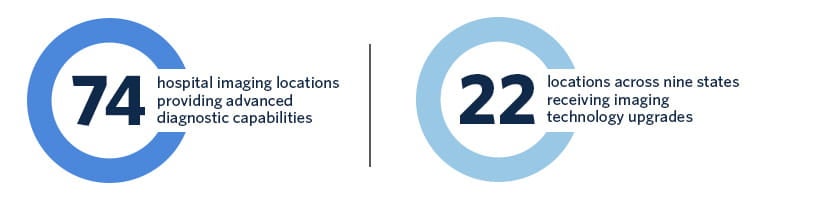
Beyond ultrasound, Ascension is deploying high-speed MRI technology that reduces scan times by up to 50%, advanced CT reconstruction technology that lowers radiation exposure by up to 82% while improving efficiency, and a unified organizational imaging platform that enables radiologists to securely access studies more quickly across multiple regions.
Bringing advanced diagnostics closer to home
Ascension is expanding access to advanced imaging by integrating multi-modality comprehensive diagnostic capabilities alongside freestanding emergency departments and medical office buildings in communities where access is currently limited. By bringing hospital-level imaging closer to where patients live and work, these sites provide timely access to advanced stroke and cardiac imaging while reducing barriers to care.
The impact of imaging transformation
Ascension’s imaging strategy builds on a broad foundation of scale, clinical excellence, and community reach. In fiscal year 2026, Ascension delivered millions of imaging services while driving the next phase of its technology transformation across the organization.
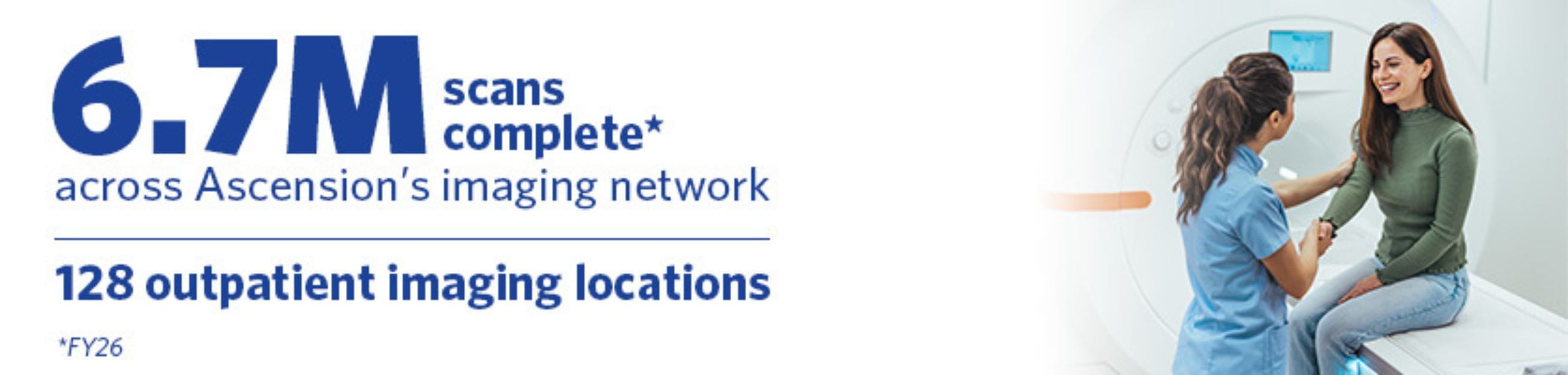
Imaging by the numbers in fiscal year 2026:
- 6.7 million scans completed across Ascension’s imaging network
- 128 outpatient imaging locations supporting greater access for patients
- 74 hospital-based imaging locations providing advanced diagnostic capabilities
- 27K mammography and X-Ray screenings completed through our expansion of mobile imaging services into rural communities.
As Ascension advances its long-term imaging strategy, the organization is investing in the technology, infrastructure, and care models needed to create a more connected diagnostic network — one that helps patients receive faster answers, equips clinicians with more advanced tools, and makes quality care more accessible.