Nursing has a way of staying with you. The instincts sharpened during overnight shifts, the ability to read a room, the reflex to prioritize what matters most don't fade when a nurse moves into leadership. For many Ascension Florida executives, years in direct patient care continue to shape how they lead today.
Each took a different route from clinical care to the executive suite, but all credit nursing as the foundation for how they approach decisions, engage with staff and keep patients at the center of their work.
This Nurses Week, we asked a few of those leaders to reflect on what nursing taught them, how they stay connected to frontline realities and what they would tell nurses considering a leadership path of their own.
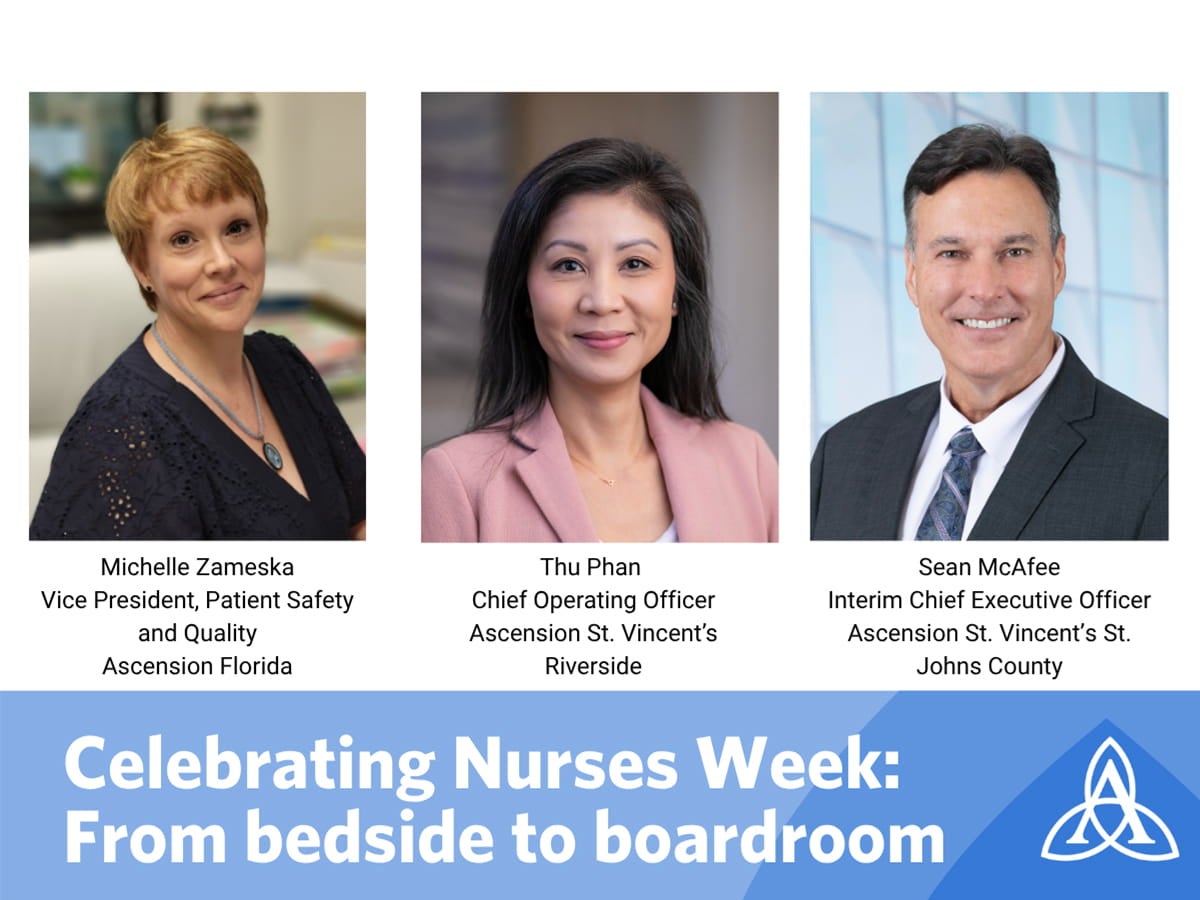
Michelle Zameska
Vice President, Patient Safety and Quality
Ascension Florida
The call to nursing came early for Michelle Zameska. As a little girl, her father was in the hospital frequently. That experience, combined with a natural love of science, made nursing a clear pathway.
“Choosing a career, I wanted it to be something that had meaning,” Zameska said. “And for me, this has meaning.”
Her leadership journey began as a house supervisor, then director of nursing. As a people person, these roles provided a perfect blend of her passions. She relishes the opportunity to serve others while also educating and mentoring her team.
In her current role as Vice President of Safety and Quality for Ascension Florida, Zameska leans on her background as a nurse to understand the viewpoint of those providing direct care. “When we talk about quality or patient safety, you have to have those who provide that direct patient care involved in making those decisions, looking at the processes, looking at safety events. We need that viewpoint to truly understand what's happening and fix things.”
Now 36 years into her nursing career, Zameska remains a wealth of knowledge, but her North Star has remained constant: it’s all about caring for patients.
"As a leader, my North Star is my patients and associates. If you understand your associates and truly care for them, they will move mountains for you. And if my associates move mountains, that means we're moving mountains for our patients."
Thu Phan
Chief Operating Officer
Ascension St. Vincent’s Riverside
Entering nursing was a journey of discovery for Thu Phan. Growing up in a household that relied on traditional eastern medicine due to a lack of health insurance, the U.S. healthcare system was largely a mystery. Choosing nursing provided a gateway to understand that system and, more importantly, to make a meaningful impact in someone’s life during their most vulnerable time.
“My years in direct patient care gave me a grounded understanding of what truly matters,” Phan said. “After seeing a wide spectrum of human experiences, you learn what is important both clinically and personally.”
The transition from the bedside began in the emergency department. While working night shifts, Phan observed the diverse career paths available to nurses and decided to explore leadership. A clinic manager took a chance on Phan for a first leadership role, opening a door that eventually led to the executive suite.
In her current role as Chief Operating Officer, Phan leans on a "triage mindset" to navigate the complexities of hospital operations. Whether balancing short-term demands with long-term strategy or coordinating care across multiple departments, her work is a direct extension of the interdisciplinary teamwork learned at the bedside.
That nursing perspective is especially vital during serious safety events. When involved in a Root Cause Analysis (RCA), Phan ensures the process remains human-centered and systems-focused. “I’ve lived the realities of the front line,” Phan said. “That experience shapes how I ask questions, how I think and how I engage the team to genuinely improve safety.”
For nurses looking to expand their impact, Phan views leadership not as leaving nursing, but as an evolution of the profession. By shifting from task-based work to systems thinking, nurses can influence quality and outcomes on a much larger scale.
“Opportunities arise from being in the right conversations and having people advocate for you,” Phan said. “Build relationships, find mentors and most importantly, be you. People appreciate authenticity.”
Sean McAfee
Interim Chief Executive Officer
Ascension St. Vincent’s St. Johns County
The call to service began early for Sean McAfee, rooted in the compassion modeled by his mother and grandmother. While his path to nursing wasn't initially planned, his journey into healthcare began at 17 during his service in the U.S. Army.
While stationed near the DMZ in Korea, McAfee was "voluntold" to become a combat lifesaver. This first exposure to providing care in high-pressure situations taught him how much people rely on one another during uncertain moments. Following his military service, he transitioned into roles as a phlebotomist and a surgical technologist in the Navy Reserve, which solidified his path in healthcare.
McAfee’s leadership journey was sparked by a mentor who encouraged him to step into a patient care coordinator role at Ascension St. Vincent’s Riverside. Though he initially felt intimidated, the investment in his growth gave him a deep understanding of supportive leadership.
In his current role as interim CEO for Ascension St. Vincent’s Riverside, McAfee leans on his nursing background to ensure every operational decision is grounded in empathy and the human impact on caregivers and patients. “Nursing taught me that relationships are at the center of everything we do,” McAfee said. “That mindset continues to guide how I lead today.”
Now a seasoned leader, McAfee remains focused on his core belief that true leadership is an act of service. He encourages nurses considering a leadership path to study the discipline intentionally and stay coachable.
“At the end of the day, the greatest fulfillment comes from knowing that, through my work, I’ve made someone else’s day or life a little better,” McAfee said. “If leadership is grounded in service and focused on supporting others, better decisions follow—regardless of the role.”