For 74-year-old Fort Walton Beach resident John Caito, everyday activities like walking across a room or standing in his workshop had become nearly impossible. John experienced excruciating leg pain that extended into the night, a symptom known as rest pain.
"I couldn't walk far and I was in excruciating pain all the time. I'd lay in bed all night long with throbbing legs. It was scary," recalled John.
At the time, John had no idea what condition was causing his symptoms or how serious the blockages were.
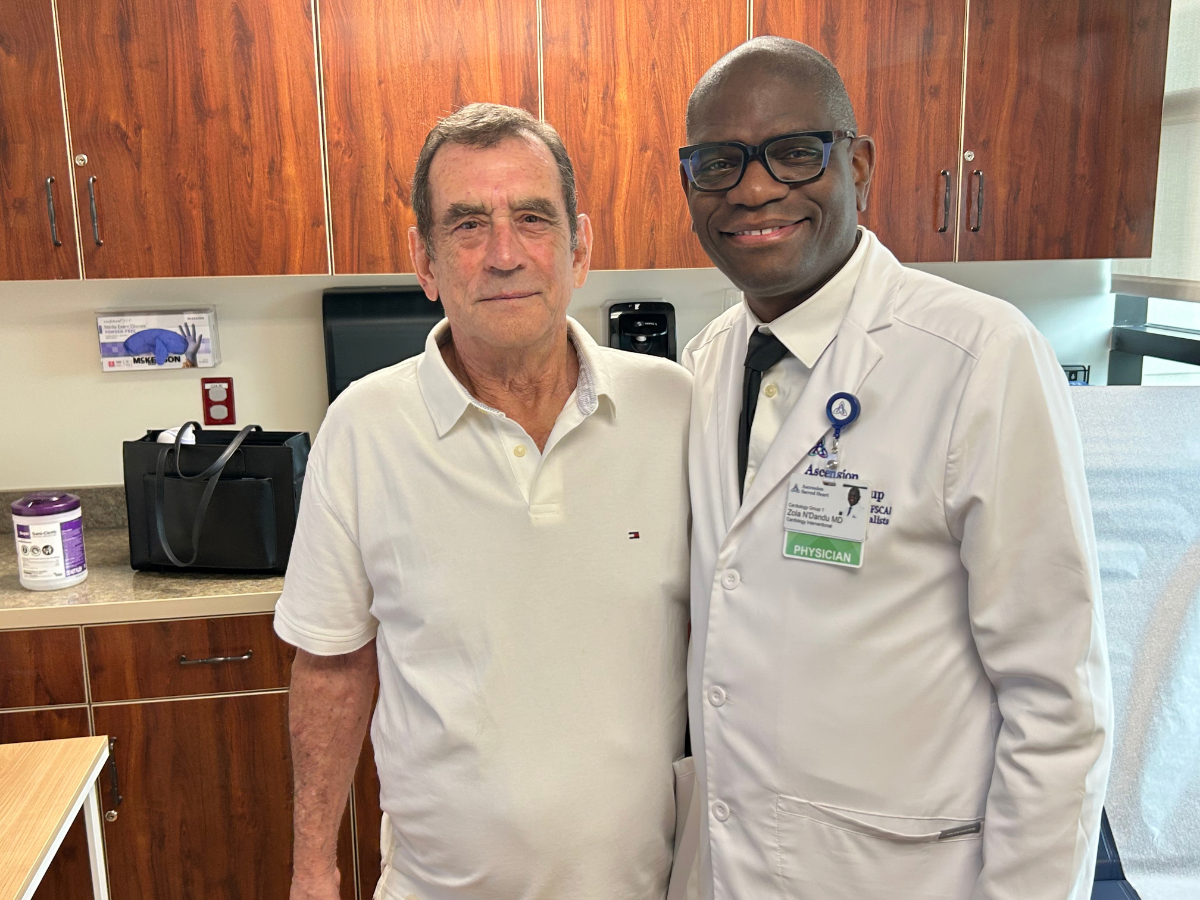
Everything changed when he sought care at Ascension Sacred Heart Pensacola. He was initially evaluated by Dr. Rohit Amin, interventional cardiologist at Ascension Sacred Heart, who diagnosed the severe circulatory blockage and connected John with fellow interventional cardiologist and limb salvage specialist Dr. Zola N'Dandu.
Dr. N’Dandu uncovered that John was suffering from severe, multi-level Peripheral Artery Disease (PAD). With zero blood flow in one leg and a 90% arterial blockage in the other, he was facing the terrifying prospect of leg amputation.
"Peripheral arterial disease is a very, very common problem," noted Dr. N'Dandu. "In the U.S., we estimate close to 12 million suffering from this, but those numbers are likely underestimated, it's probably close to 20 million or more because so many people are undiagnosed and undertreated. It's a common problem that lacks proper awareness."
Comprehensive Evaluation and Advanced Intervention
At Ascension Sacred Heart, Dr. N'Dandu and the cardiovascular team conducted a meticulous, step-by-step diagnostic evaluation. Using non-invasive tests such as an ankle-brachial index (ABI) and ultrasound, followed by a 3D CT reconstruction scan, Dr. N'Dandu precisely mapped the multi-level blockages spanning from John's abdomen down to his feet.
Dr. N'Dandu performed a minimally invasive endovascular procedure using advanced technology, including intravascular ultrasound (IVUS) inside the artery for 360-degree visualization and exact stent sizing. Specialized balloons and modern covered stents were delivered through tiny catheters to reopen the clogged arteries and fully restore blood flow.
Thanks to these advanced techniques, John avoided open surgery and major amputation entirely, achieving mobility within 24 hours of the procedure and returning home shortly after.
"We don't help patients just by improving their blood flow; we help them by preserving their limbs, which then ultimately allows them to remain independent, ambulatory, and live good lives," said Dr. N'Dandu. "When we diagnose patients early, it becomes an opportunity for us to treat them, address their risk factors, and slow the progression of the disease".
A Remarkable Recovery and Multidisciplinary Support
Following the procedure, John experienced a 90% improvement in his mobility and leg health. Today, he is back to working in his workshop, staying active from morning until evening, and participating in a remote supervised exercise and nutrition program.
"I go all day long now. All day long. I'm ready to sit down at five or six o'clock, but who isn't at 74?" shared John. "What Dr. N'Dandu did for me was remarkable. I'm so grateful... there are no words other than thank you".
Dr. N'Dandu emphasizes that successful limb preservation relies on a cohesive, multidisciplinary team approach encompassing interventional cardiology, vascular surgery, wound care, podiatry, and rehabilitation.
"It's an entire team effort—from primary care to Dr. Amin, our nurses, imaging specialists, and post-procedural care teams," said Dr. N'Dandu. "When we all come together, that's when our patients have a chance to succeed and do well".
The Critical Importance of PAD Awareness
Peripheral Artery Disease affects an estimated 12 to 20 million Americans, impacting 1 in 20 adults over age 50 and 25% of individuals over age 70. Despite its high prevalence, PAD remains widely underdiagnosed and undertreated across the nation. Many individuals mistake early symptoms, such as leg cramping while walking (claudication) or foot numbness, for normal signs of aging.
Left unaddressed, severe blockages can lead to chronic limb-threatening ischemia, non-healing ulcers, and preventable amputations. Dr. N'Dandu advocates for heightened awareness among both medical providers and the community, urging individuals experiencing leg pain, poor circulation, or non-healing wounds to seek early screening and second opinions.
"Many of us, in the medical community and the community at large, are not fully aware of peripheral artery disease or how it presents," noted Dr. N'Dandu. "We need to do a better job of educating ourselves and educating the community so we can diagnose these patients early and provide life-saving care".
Advancing Medical Education and Regional Leadership
Beyond his clinical practice at Ascension Sacred Heart, Dr. N'Dandu actively contributes to advancing limb preservation on a national and regional scale. As a recognized expert in the field, he frequently serves as a speaker and faculty member at prominent medical conferences. He is also instrumental in leading regional educational initiatives, such as organizing the upcoming Panhandle Wound and Limb Preservation Summit. Through these efforts, Dr. N'Dandu continues to champion multidisciplinary approaches and enhance provider education to improve outcomes for patients with complex vascular conditions.
For John Caito, the expertise Dr. N’Dandu brings to Northwest Florida has made all the difference in the world. "I mean, I have two legs and two feet now and all my toes... I'm going all day long now... Like day and night," shared John.