There are moments that stay with healthcare workers long after the moment passes. For Richard Vigil, it was the drive home after his first code, when a pediatric patient didn't make it and the shift simply had to move on.
""I remember driving home,” he said. “It was one of the first times I drove in silence."
That quiet commute stayed with Vigil long after the day ended, carrying the weight of what clinicians absorb after a patient doesn't make it, and what families deserve in those first moments of loss.
Vigil, now SEAL Team coordinator at Studer Family Children's Hospital at Ascension Sacred Heart in Pensacola has spent the past two years building an answer.
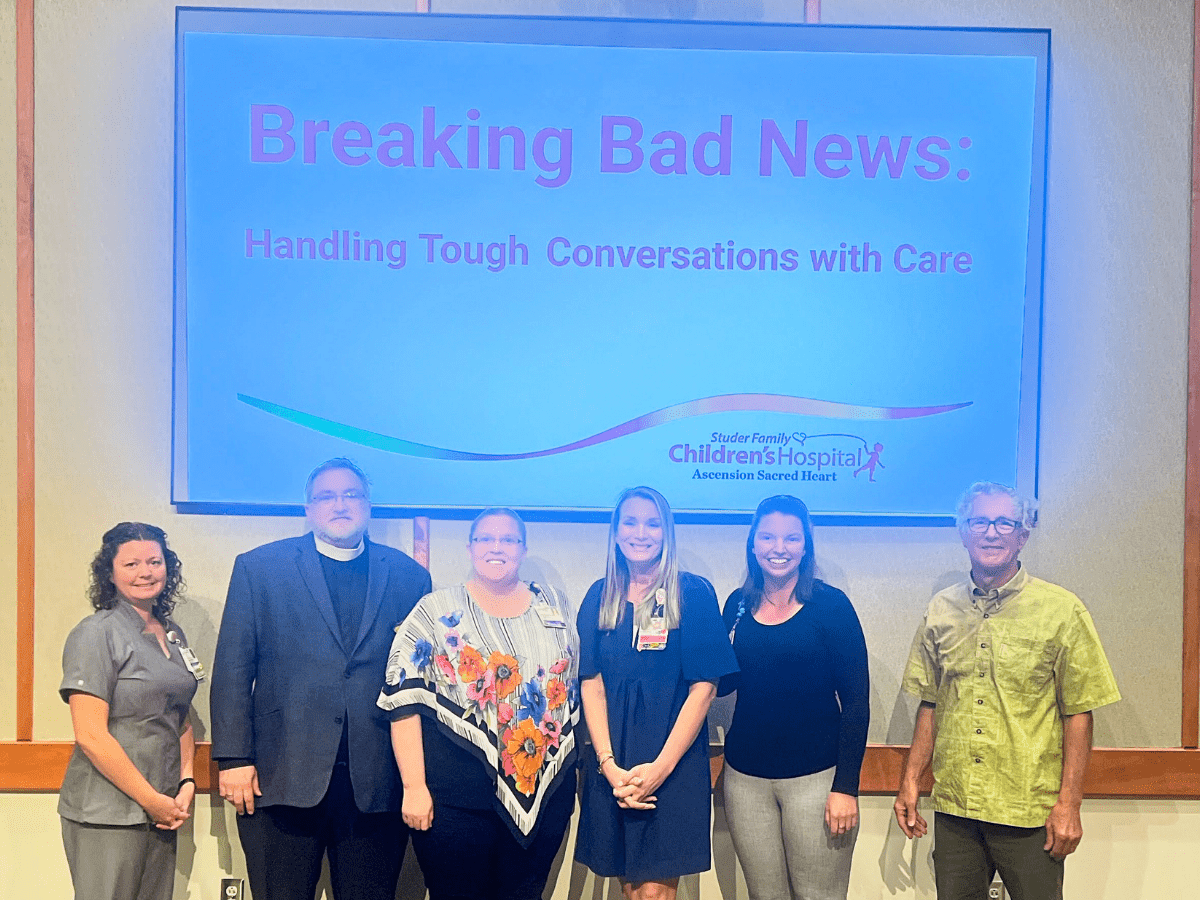
In collaboration with Dr. Jeffrey Beard, director of the Pediatric Emergency Department at Children’s Hospital, Teresa Williams, APRN, clinical programs coordinator at Sacred Heart, and Rachel Hershberger, APRN, a pediatric palliative care consultant, Vigil developed a multidisciplinary resident training project focused on delivering difficult news to patients and families, with attention to the self-care practices that help clinicians sustain that work. The program combines validated self-assessment, live simulation and structured education.
The gap Vigil identified years before took root years later at a cross-departmental class, where colleagues from other units described how their teams processed loss: a manager who brought in donuts, a group debrief, a few minutes of shared acknowledgment. When the topic turned to the ER, Vigil heard a different answer.
"In the ER, we don't have that luxury," he said. "When we have a negative outcome, we still have a full patient load. We step out of the trauma bay and put on a happy face, because our other patients need us."
Residents step into the same reality Vigil described, often without formal preparation. As a major training site for the region's next generation of physicians, Ascension Sacred Heart is positioned to shape how these doctors handle the hardest moments of their careers before they face one alone. The training builds that preparation through four phases: an initial self-assessment using the validated Breaking Bad News Attitude Scale; a live simulation in which residents respond to a code with a negative outcome and then notify a standardized "family"; a structured education session; and a follow-up simulation to measure growth.
The education sessions draw on disciplines that rarely share a teaching platform. Child Life Specialists, Spiritual Care, nursing and medicine each present elements of the SPIKES protocol, a nationally validated framework covering setting, perception, invitation, knowledge, emotions and strategy. The model is already being mapped for outpatient settings, where the same principles apply to delivering a diagnosis.
The integration of chaplaincy is intentional. So is the program's attention to what happens after the conversation ends.
"Everyone involved is passionate about this because it directly affects them," Vigil said. "Most everybody has been on the receiving end of this kind of news."
Vigil has been, too, navigating his own family's losses through the healthcare system and experiencing firsthand what a provider's presence can offer, and what its absence costs.
In the first cohort, 30 residents completed the live simulations and 53 associates attended the SPIKES didactic sessions. Analysis of the BBNAS results showed statistically significant improvement (P<0.01) in clinicians' confidence delivering difficult news.
"It's never going to be a comfortable conversation," he said. "We just want to make sure families are held well in the worst moments of their lives, and that the people walking back out into that hallway aren't doing it alone."